Quality, Margins, Freight & Service
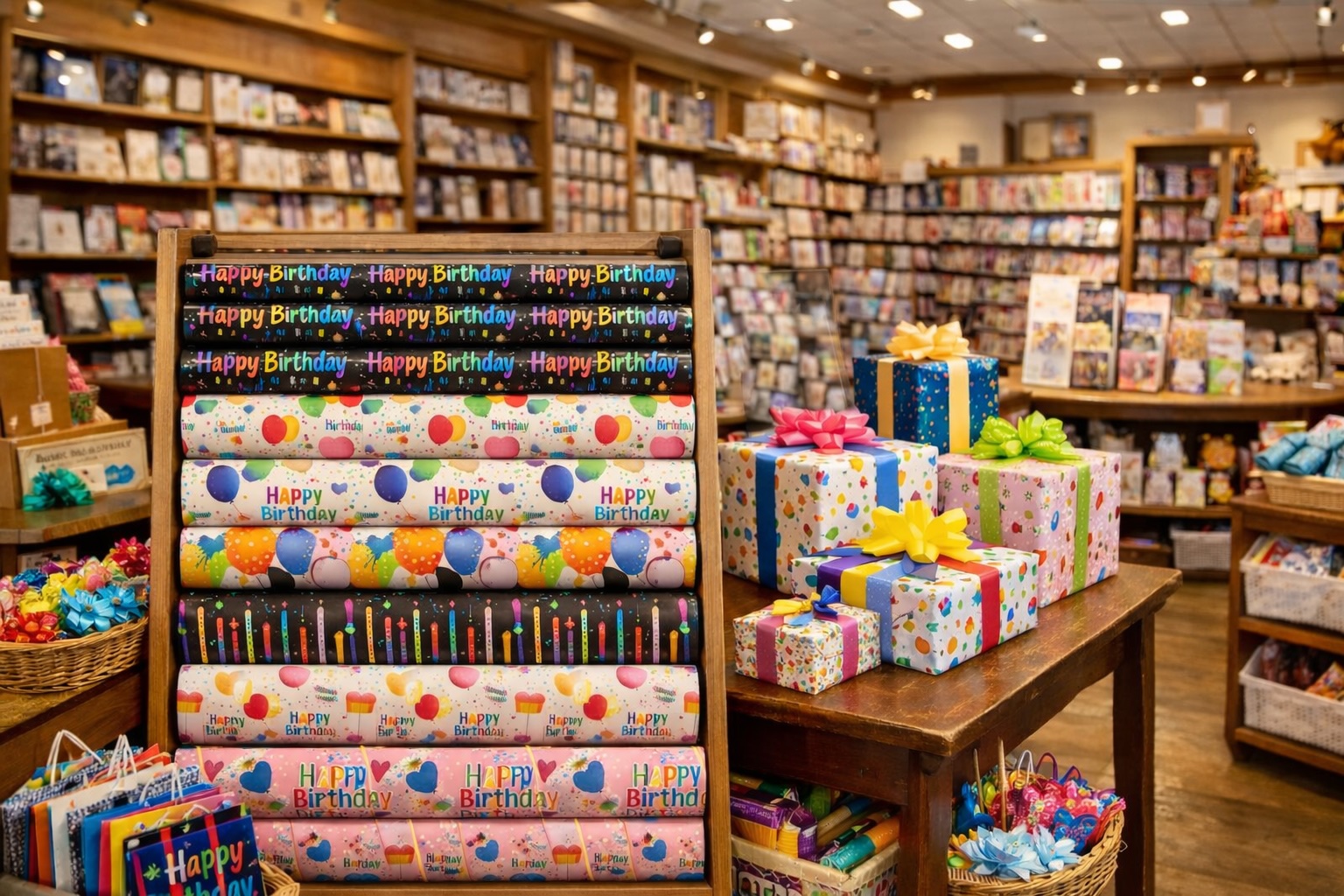
Every time a customer requests a gift wrap, you face a financial choice: are you paying retail prices for a service you provide for free? Relying on standard 5-meter rolls from a local craft store acts as a silent profit leak, costing significantly more per square foot than industrial options. For retailers, switching to bulk happy birthday wrapping paper is an easy way to slash overhead and upgrade the customer experience.
We have all experienced the frustration of the “Saturday Rush,” where thin, discount paper tears on a box corner and forces a complete re-wrap. In practice, professional-grade materials provided by wholesale gift wrap suppliers for small businesses offer superior density and opacity, preventing these wasteful moments. This shift does not just save time; it turns every package leaving your counter into a durable, premium reflection of your brand that survives the trip home.
Analyzing the cost-benefit of offering in-store gift wrapping requires breaking down the specific math behind the switch. From calculating your true cost-per-gift to navigating weight specifications, establishing exactly how heavier stock protects your margins is critical. Mastering these procurement details ensures your complimentary service supports, rather than strains, your store’s profitability.
What is the Ideal Thickness? Decoding Paper Weight to Prevent ‘Corner Poke-Through’
Nothing kills the momentum of a busy rush faster than birthday gift wrap that tears on the first fold. This frustration usually boils down to low tensile strength , a technical term for how much tension the paper can handle before snapping on a sharp box corner.
To avoid this, look for the # (lb.) rating on the roll. Think of it simply: standard printer paper is usually 20#, cardstock like the kind used for business cards or invitations is around 90#.
Finding the ideal weight (lb.) for retail gift wrap is a balancing act between durability and foldability. If the paper is too light, you face “opacity” issues where the gift inside is visible through the print. If it’s too heavy, your staff will struggle to create crisp creases, slowing down service.
Consider these guidelines when upgrading or downgrading:
- 35 # (Economy): Thinner paper for wrapping soft items; prone to tearing at the corners.
- 55 # – 65# (Premium): Luxurious feel, opaque, holds the fold, and resists corners poke-through; can be exquisitely embossed.
Investing in tear-resistant premium wholesale wrapping paper reduces waste immediately because you aren’t using two sheets to cover one mistake. A simple quality test is to hold a sample against a bright light; if you can clearly see your hand shadow, the opacity is likely too low for professional use.
Once you have the right weight, the next factor in wrapping speed is the surface texture.
Matte vs. Gloss? Choosing Finishes for Fast Wrapping and Fingerprint Resistance
While weight determines durability, the finish determines how quickly your staff can get happy customers out the door with beautiful packages in hand. Choosing between uncoated and gloss finish happy birthday paper is often a trade-off between visual vibrancy and mechanical friction. High-gloss papers look festive and classic, reflecting light to catch the eye, but they can be slippery to handle and often repel standard adhesives, requiring heavy-duty tape to keep seams closed. Conversely, matte or uncoated finishes provide a “toothier” surface that standard transparent tape grips instantly, saving precious seconds during a rush.
Retailers looking for a middle ground often utilize Spot UV coatings, where a glossy layer is applied only to specific design elements rather than the entire sheet. This technique is frequently found on popular children’s birthday paper motifs, adding a shiny, tactile “pop” to balloons or characters while leaving the background matte for easier handling. This approach also minimizes the visible fingerprints that plague high-gloss solid colors, ensuring the gift looks pristine from wrapping to unwrapping.
Your choice of finish ultimately communicates your store’s personality before the gift is even opened. A boutique selling artisanal goods might prefer the understated elegance of a matte finish, while a toy store generally benefits from the high-energy reflection of glossy happy birthday wrapping paper.
Once you have selected the right weight and finish for your operations, the final step is ensuring you purchase the correct volume to cover your demand.
How Much Should I Buy? Calculating Your Birthday Gift Wrap Inventory Needs
Nothing disrupts the checkout flow like reaching for a roll that isn’t there, but overstocking a pattern that won’t get used is equally damaging to your bottom line. Instead of guessing based on gut feeling, effective inventory management starts by converting your sales data into physical dimensions.
Determine exactly how to calculate retail gift wrap inventory needs by moving away from counting “rolls” and focusing on “linear meters” using this simple estimation method:
- Track Daily Volume: Estimate the average number of gifts wrapped per day during non-holiday periods.
- Apply the Standard: Multiply that number by 0.75 meters (the industry average length needed for a standard shoebox-sized gift).
- Project Annually: Multiply the daily total by your operating days to find your total meter requirement before browsing catalogs.
Most wholesale wrapping paper supplier catalogs enforce an MOQ (Minimum Order Quantity), which is the smallest amount you can purchase to unlock bulk pricing. You can navigate this without tying up cash flow by applying the “Golden 70% Rule”: commit 70% of your total meter requirement to gender-neutral bulk birthday wrapping paper (like geometric shapes or simple balloons) that works for any age or gender. This allows you to meet the MOQ on versatile rolls while reserving the remaining 30% of your budget for smaller runs of niche, trend-focused prints.
Alternatively, you can look for bulk wrapping paper suppliers who offer wholesale pricing for any quantity, large or small. Better yet, find a vendor who offers a low-price guarantee, and turn that into guaranteed cost savings for you.
How Can I Minimize Shipping Costs? The Hidden Math of Freight and Storage
Shipping costs can quickly erode the savings gained from bulk discounts if you ignore freight calculations. Carriers often use “Dimensional Weight,” charging based on the space a package occupies rather than just its heaviness. Since premium jumbo rolls have significantly more volume than standard retail sheets, long industrial tubes often incur higher rates. When vetting potential suppliers, be sure to check shipping policies—and, ideally, find one who has a free freight option.
Once the delivery arrives, the footprint of industrial supplies can overwhelm a cramped stockroom. Laying rolls horizontally on shelves is a common mistake that wastes surface area and causes flat spots on the paper from uneven pressure. One of the best practices for storing bulk paper rolls is utilizing vertical space; keeping rolls upright in a grid or dowel system reduces the floor footprint by half and prevents the paper from wrinkling or tearing before it ever reaches the counter.
Optimizing logistics does more than save money; it reduces the carbon footprint associated with inefficient transport and damaged goods. With the right materials in hand, the final puzzle piece is organizing your workspace to keep those sustainable rolls accessible and ready for the rush.
Setting Up a Professional Gift Wrapping Station for Efficiency
Organizing a professional gift wrapping station starts with anchoring your heaviest assets. Unlike lightweight consumer tubes, a standard industrial birthday wrapping paper roll can weigh over 15 pounds, making it awkward to handle. Installing a dispenser with a weighted tear-bar transforms this bulk into an advantage, allowing staff to pull and cut clean sheets with one hand while securing the box with the other. This setup creates enough tension to slice through thick paper without jagging, increasing wrapping speed by roughly 25% during the holiday rush and significantly reducing employee fatigue compared to using handheld scissors.
Even with precise cutters, awkward off-cuts are inevitable when sizing paper for varied inventory. Rather than crumpling these pieces, successful boutiques implement “scrap-to-tag” repurposing, where staff use decorative punches to turn scraps into matching gift tags or branding accents. This technique squeezes value out of every square inch and creates a cohesive presentation that feels custom rather than commercial. With your materials sustainable and your station optimized for speed, the final challenge is mastering the purchasing timeline.
Your Bulk Buying Action Plan: From Selection to Storage
Strategic inventory planning changes how you approach every sale. By sourcing bulk happy birthday wrapping paper online, you stop treating gift wrapping as a costly chore and start leveraging it as a branding opportunity that survives the checkout rush. You now possess the insight to lower your cost-per-gift while upgrading the durability and look of every package leaving your counter.
Ready to finalize your stock order? Use this checklist to secure the best wholesale birthday gift wrap:
- Audit usage: Calculate last year’s volume to predict accurate roll counts.
- Check paper weight: Aim for 55# – 65# to create a high quality presentation and prevent tearing.
- Verify MOQ: Confirm minimums match your back-room storage capacity.
- Optimize Shipping: Bundle your birthday gift wrap with other supplies to reduce freight costs.